
The Impact of AI Search on E-Commerce

Updated: Apr 9
The AI search market is expanding dramatically. It is projected to grow from USD 18.5 billion in 2025 to USD 66.2 billion by 2035. Retail and e-commerce are expected to account for 42% of the market in 2025. The impact is immediate and measurable. Retailers are experiencing 1,300% increases in traffic from generative AI searches compared to the previous year. AI search visitors stay 8% longer on websites, explore 12% more pages, and are 23% less likely to bounce than traditional search referrals.

Shift from Click-Based to Zero-Click Commerce
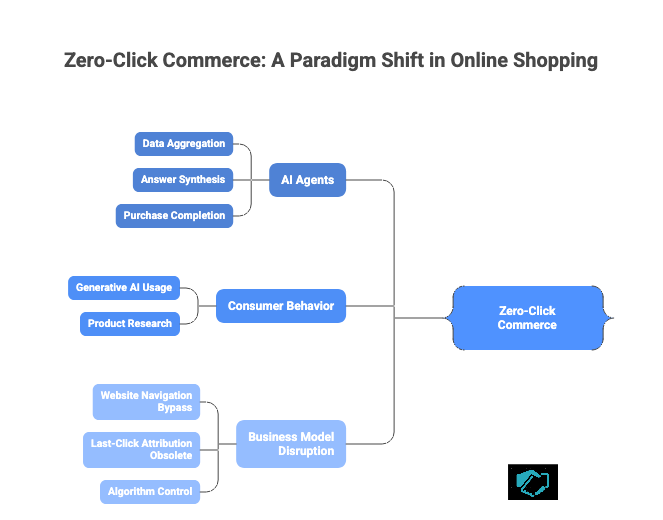
The most significant business model disruption is the emergence of zero-click commerce. In this model, customers bypass traditional website navigation entirely. Rather than users clicking through to product pages, AI agents now:
Aggregate data across multiple retailers simultaneously, ensuring consumers receive the best possible deal regardless of platform.
Synthesize answers directly within AI interfaces. For example, a user asking, "What are the best running shoes for marathon training under $150?" receives three specific models with summarized reviews rather than having to visit ten websites.
Complete purchases within conversational interfaces, with transactions potentially fulfilled on your site via APIs or within third-party platforms. This makes traditional last-click attribution obsolete.
This represents a critical shift. 33% of consumers have already used generative AI for online shopping, with 55% using it for product research. The control of the shopping journey is shifting from brands and consumers to algorithms operating across multiple platforms.
Custom-Sized Products: Unique Vulnerabilities and Opportunities
For businesses selling custom-sized, made-to-order, or personalized products, AI search creates distinctive challenges that differ sharply from standardized product categories.
The Personalization Data Problem
Custom sizing relies on intricate customer-specific data: body measurements, fit preferences, fabric considerations, and style nuances. Traditional AI recommendation systems trained on aggregated customer behavior struggle with the complexity of bespoke customization. The challenge intensifies when third-party AI agents aggregate your offerings alongside competitors. They lack the deep contextual understanding of each customer's unique requirements. A customer's preference for "tight around the bust" or fabric elasticity expectations becomes invisible to AI comparison engines that prioritize price and generic specifications.

Inventory Complexity
Custom-sized products typically involve on-demand manufacturing or highly fragmented inventory across multiple size variations. AI search systems require comprehensive, standardized product catalogs with complete attribute data. When your business model involves manufacturing to order, maintaining the real-time inventory visibility that AI search engines expect becomes operationally complex.

Core Business Model Transformations Required
1. Data Quality and Catalog Enrichment Become Strategic Assets
The foundation of AI search success is comprehensive, accurate product data. Incomplete or inconsistent product attributes directly degrade search quality. Businesses must now:
Implement AI-driven catalog enrichment tools to automatically fill missing attributes, normalize variant data, and standardize terminology across thousands of SKUs.
Ensure every product variant has complete specifications. For custom-sized items, this means documenting fabric elasticity, fit characteristics (tight, true-to-size, loose), and design-specific measurement guidance.
Continuously update product data based on customer feedback and return patterns.
The operational shift is substantial. Manual catalog management becomes infeasible. Enterprises are automating product description generation, attribute tagging, and schema normalization to maintain the data quality AI systems demand.

2. Inventory Management Becomes AI-Driven and Predictive
Traditional push-based inventory planning—manufacturing based on seasonal forecasts—no longer suffices. AI search's ability to identify emerging demand signals in real time requires inventory systems that can respond dynamically.
For custom-sized products, this means:
Demand forecasting that considers micro-trends in size preferences, color preferences, and style evolution.
Predictive inventory optimization that balances manufacturing lead times against AI-identified demand fluctuations.
Autonomous replenishment systems that trigger production orders when thresholds are met, without manual intervention.

Organizations implementing AI inventory management report 40% faster order processing, 35% higher operational efficiency, and 30% fewer stockouts. This is not optional competitive overhead—it's essential to serve the real-time nature of zero-click commerce, where AI agents may route customers to you based on instant availability signals.

3. Shift from Brand-Owned Distribution to Multi-Platform Presence
Agentic AI disrupts the traditional retailer-centric model by eliminating platform dependencies. Your products no longer live exclusively on your website; they exist within AI agent databases that compare across multiple marketplaces. This fundamentally changes how businesses must operate:
API-first architecture: E-commerce platforms must expose product data, pricing, availability, and fulfillment capabilities via APIs so that third-party AI agents can access real-time information.
Standardized product feeds: Consistent participation in multiple AI shopping interfaces (OpenAI Shopping, Naver AI Shopping, Meta, TikTok) requires maintaining standardized product information across diverse platforms.
Dynamic pricing and bundling: As AI agents compare you directly against competitors in real time, static pricing becomes a competitive liability.

4. Personalization at Scale Becomes Essential
AI search amplifies the shift toward 1:1 personalization. Rather than segmenting customers into broad groups, AI systems deliver uniquely tailored experiences for each user. For custom-sized product businesses, this means:
Size recommendation engines that analyze customer body data, fit preferences, historical purchases, and garment-specific characteristics to predict ideal fits. Retailers using AI size recommendation solutions report 25-30% reductions in return rates and 15-20% increases in repeat purchases, as customers gain confidence in fit predictions.
Individual style profiling that learns customer aesthetic preferences over time and proactively surfaces relevant customization options. This requires fundamentally different technical infrastructure. Your business must shift from catalog-and-browse to data-collection-and-intelligence, continuously capturing and analyzing customer preferences.

5. Supply Chain Autonomy and Real-Time Responsiveness
AI agents making purchase decisions in real time create pressure for autonomous supply chain operations. Manual procurement, supplier coordination, and production scheduling become bottlenecks. Businesses must implement:
Agentic procurement systems that autonomously negotiate with suppliers, place purchase orders, and manage supplier relationships within defined guardrails.
Shelf monitoring and dynamic replenishment that responds to AI-detected demand shifts without waiting for human decision-makers.
Predictive logistics and route optimization that use live data (weather, traffic, port conditions, carrier performance) to recommend efficient fulfillment strategies.
For custom-sized products, this extends to autonomous production planning that balances customer demand signals identified by AI with manufacturing capacity constraints.

Traditional marketing metrics become obsolete in zero-click commerce. If an AI agent initiates a sale in a chat interface but fulfillment occurs on your site via API, how do you attribute the conversion? Your analytics infrastructure must evolve to:
Track customer journeys across multiple touchpoints and platforms.
Attribute revenue to AI-driven discovery sources, not just last-click website visits.
Measure success through metrics like conversion rate, customer lifetime value, and repeat purchase frequency rather than traffic volume.

Summary of Required Operational Changes for Custom Sizing

Implications for Partnerships
Where to Focus Partnership Efforts
For a brand selling custom-sized products, three partnership lanes are likely to be the highest leverage in the next 12–24 months:
AI fit & measurement stack: Deep integration with leading sizing/fit partners plus any necessary body-measurement or virtual try-on tools, with shared access to return/fit data loops.
Agentic distribution & discovery: Early, API-rich partnerships with major AI shopping platforms and AI-ready marketplaces, aiming for preferred status in your category and tight feedback on how agents interpret your catalog.
Operational & manufacturing autonomy: Partnerships with on-demand manufacturers, CAD/pattern vendors, and 3PLs that can expose real-time capacity and support autonomous, AI-triggered production and fulfillment decisions for custom orders.

Not all partnerships deliver equal returns. In the AI search era, where you invest first matters enormously.
The chart below maps key partnership areas by how much effort they require to implement versus the strategic impact they're likely to deliver. The size of each bubble reflects the data leverage potential—how much proprietary value you can build from that relationship over time.
The insight is clear: the Fit & Measurement Stack sits in a compelling sweet spot—high strategic impact without being the most effort-intensive to establish. Meanwhile, Agentic Distribution and Operational Autonomy demand more implementation work, but their impact justifies the investment. Data Rights Governance and AI Catalog Management, while lower on both axes, are foundational dependencies that quietly enable everything above them.
The takeaway: sequence matters. Lead with fit intelligence partnerships to build your data moat early, then layer in distribution and operational autonomy as your infrastructure matures.

Commercial and Governance Implications
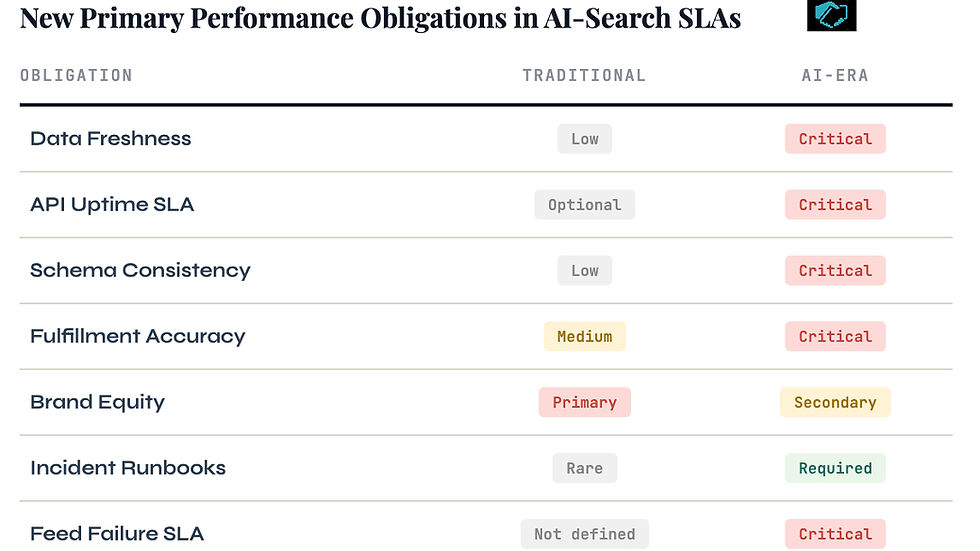
Because AI search rewards system integrity and reliability over pure brand equity, partnership contracts must now emphasize data freshness, API uptime, schema consistency, and fulfillment accuracy as primary performance obligations. SLAs and joint runbooks for incident management (e.g., feed failures, sudden stockouts, capacity constraints on made-to-order lines) will directly impact whether your products are shown or suppressed by agents.
Data rights and privacy become a central negotiation topic. Partners will want to train their models on your fit and behavioral data, while you will want rights to derived insights, exportable sizing models, and the ability to reuse those learnings across channels and future partners. Structuring co-development or “shared improvement” clauses—where both parties benefit from model improvements driven by your data—can turn a vendor relationship into a long-term, defensible partnership.

Conclusion
AI search is not a marginal disruption—it fundamentally reorganizes how e-commerce businesses operate. For companies offering custom-sized products, the competitive advantage shifts from brand awareness and customer acquisition to data quality, operational agility, and AI-native supply chain design. Businesses that successfully transition will see the benefits: 20-30% increases in conversion rates, 48% higher average order values, and sustained customer loyalty through superior personalization. Those that delay will face declining visibility as control of the shopping journey migrates to AI agents that prioritize speed, comparison, and real-time availability signals—capabilities that require deep operational transformation, not merely adopting search tools.

Author

Gianluca Caccamo connects leaders with data for strategic partnerships, after more than 15 years at companies like Google, Pinterest, and Wix among others. Advising companies on E-commerce, Advertising, SaaS, and AI Partnerships. [Linkedin]


Comments