
The Economics of AI Pricing: LLM Costs and Net Effects on the SaaS Industry

Data verified as of 14 September 2026
The monetisation strategy for Large Language Models is a complex balance between enormous upfront capital expenditures for training, and variable operational expenditures for live inference. Providers manage this through a sophisticated, multi-layered pricing model — the single blended per-token price has given way to a matrix of input, cached input and output rates, multiplied by context-length tiers, in which the cheapest and most expensive line on the same rate card differ by a factor of fifty.
The same pressure has reshaped the SaaS layer above it. Because inference cost scales with usage rather than headcount, the per-seat subscription that defined software for two decades is being restructured into a hybrid: a seat-shaped surface customers can budget against, a credit layer that absorbs usage variance, and an outcome layer for cases where the AI genuinely does the work.
1. What Drives Computing Costs for LLMs
LLM providers carry two very different cost buckets: enormous training costs, and a smaller but continuous inference cost on every single request.
A. Training Costs (CapEx)
These are episodic but enormous, and increasingly split across more than one phase.
1. GPU compute time. Training a frontier model still costs $100M–$1B+ in compute. What has shifted is where that money goes: Epoch AI's analysis found GPT-5 used less pre-training compute than GPT-4.5, with spend migrating into post-training — reinforcement learning, reasoning distillation and alignment. Training is no longer one monolithic run followed by years of serving; it is a continuing programme.
The GPUs themselves remain the anchor cost. NVIDIA's Hopper generation (H100, H200) still sets the floor, with Blackwell (B200 and the rack-scale GB200) now the leading edge:

2. Data acquisition and cleaning. Licensing datasets, human annotation, RLHF and alignment work, plus quality control for safety and evaluation.

3. Engineering and research headcount. Reinforcement learning specialists, systems engineers, distributed compute and evaluation infrastructure experts.

Key insight: Training cost is amortised over many years and across billions of tokens served, materially reducing its impact on the final per-token price. But as post-training becomes continuous, this line behaves less like a one-off capital charge and more like an ongoing R&D expense — which is why price cuts now arrive faster than any amortisation schedule would predict.
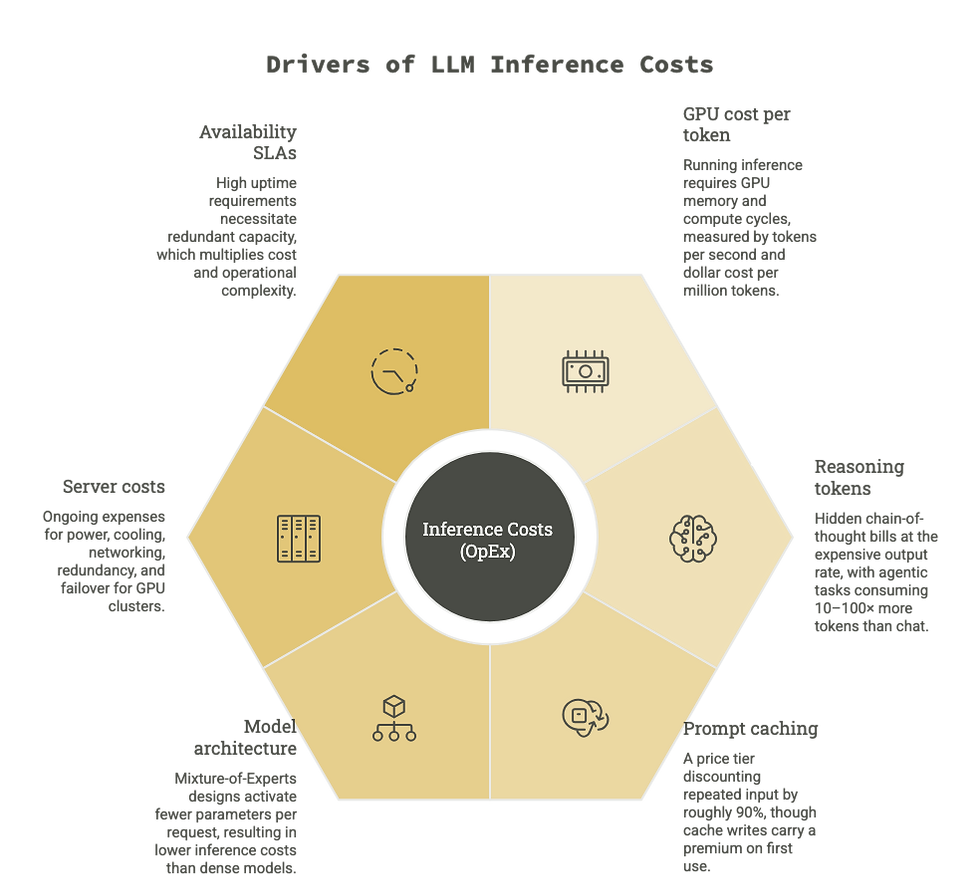
B. Inference Costs (OpEx)
This is the ongoing cost that flows into pricing, since every API call consumes compute.
1. GPU cost per token. Running inference requires GPU memory and compute cycles. Providers measure tokens/second/GPU and $/million tokens. The rules of thumb hold: larger models mean higher inference cost, and longer context windows mean more computation per request — the latter now explicitly priced through context tiering.

2. Reasoning tokens. On reasoning models the hidden chain-of-thought bills at the output rate, the most expensive line on any rate card. Google's documentation confirms Gemini output pricing includes thinking tokens. A single agentic task can consume 10–100× the tokens of a chat turn, and this asymmetry is the direct cause of the credit-metering wave that swept SaaS in 2026.

3. Prompt caching. Caching has moved from an optimisation technique to a published price tier, and is now the single largest lever on real cost. Every major provider discounts repeated input — a stable system prompt, a fixed document, a long conversation history — by roughly 90% against its base input rate:
Model | Base input $/M | Cached input $/M |
gpt-6-astra | $10.00 | $1.00 |
gpt-5.6-sol | $4.00 | $0.40 |
Claude Opus 5 | $5.00 | $0.50 |
Claude Sonnet 5 | $3.00 | $0.30 |
Gemini 3.1 Pro | $2.00 | $0.20 |
The 90% figure needs one qualification, because it is routinely misread as a 90% saving on the bill. It is not. The discount applies only to the input side of the meter, and only to the portion that is actually a cache hit — output tokens can never be cached, and output is the expensive side of every rate card. A realistic agentic request with 50,000 input tokens and 2,000 output tokens, moved from zero caching to a 90% cache-hit rate, gets about 68% cheaper, not 90%:
Cache writes also carry a premium on first use — $12.50/M on gpt-6-astra, while Anthropic charges $6.25/M for 5-minute and $10/M for 1-hour cache writes on Opus 5. Caching therefore pays back only when the same prefix is read several times before the cache expires; a one-shot request that writes and never re-reads costs more than not caching at all.

4. Model architecture. Mixture-of-Experts designs activate only a fraction of parameters per request and therefore carry lower inference cost than dense models. No frontier lab publishes architecture details for its current models, but the hardware roadmap makes the industry default clear: NVIDIA's Rubin platform claims a 4× reduction in the number of GPUs required to train MoE models versus Blackwell — a claim that only makes commercial sense if MoE is the standard.

5. Server costs. Power and cooling for GPU clusters, networking, redundancy and failover.
6. Availability SLAs. High uptime requires expensive redundant capacity. Each additional "nine" (99.9% → 99.99% → 99.999%) cuts allowed downtime roughly 10× while multiplying cost and operational complexity several times over.
C. The Common Denominator: Rented GPU-Hours
Training and inference look like very different activities. One is a months-long project; the other happens in a fraction of a second. But they are paid for in the same currency, and it is worth being precise about what that currency is — because it is not the price of a graphics card.
Why the sticker price of a GPU is the wrong number
The figure most often quoted in discussions of AI cost is the price of an NVIDIA H100: roughly $25,000 to $40,000 for a single card, depending on the version. It is a memorable number, and it is almost never the number that matters.
Providers do not build a training budget or a per-token price by counting cards. They count time on a machine. Training a model occupies thousands of GPUs for weeks, which is measured in GPU-hours. Answering a single API request occupies a fraction of one GPU for a moment, measured in GPU-seconds. Different scales, same meter. The useful comparison is a commercial vehicle fleet. What a lorry costs to buy tells you very little about what it costs to move a pallet. What matters is the hourly cost of having the vehicle available, and how full it is when it drives. AI infrastructure works the same way: the relevant unit is the rented GPU-hour, and the relevant question is how many tokens a provider can push through that hour.
This is why a single rental market sets both figures at once — the amortised training charge described in bucket A, and the marginal cost of serving a request in bucket B.
What an hour of compute actually costs
Two kinds of supplier rent out this capacity. Hyperscalers are the large general-purpose clouds (AWS, Azure, Google Cloud). Neoclouds are specialist providers that do little except rent GPUs — CoreWeave, Lambda, Nebius and similar. Both offer the same silicon at very different rates.

Two things this table explains
The same chip rents for wildly different prices. A hyperscaler charges roughly three to five times what a neocloud charges for identical hardware. That gap is the reason large inference workloads have moved to specialist providers, and it is the main reason two companies serving the same open-weight model can publish prices an order of magnitude apart. When a competitor's pricing looks impossible to match, the explanation is usually where they rent, not what they run.
The hardware loses value faster than it is paid off. A used H100 now sells for $6,000 to $22,000 — a fraction of its new price — even though the card is still in heavy production use. Anyone who bought at the original price is holding an asset falling in value while the debt behind it stays fixed. The rational response is to cut prices, win volume and keep the machines busy, rather than hold out for margin on idle hardware. This is one of the forces behind the price collapse, and it is a supply-side pressure rather than a technology improvement.
2. How Providers Convert Costs to Pricing
Pricing is built from two components: a core per-token economic unit, and productisation layers stacked on top.
Cost per Million Tokens ($/M)
This remains the core-physics economic unit. Providers know what it costs to generate a million tokens, then price above it. What has changed is that a single figure per model tier no longer describes any real rate card. Here is the September 2026 landscape:

Two structural features matter more than any individual number:
Output costs 4–6× input, universally — the most consequential fact for cost modelling, and the one that disappears inside any blended per-token figure.
And context tiering is now standard on flagship models: Gemini 3.1 Pro doubles input price and raises output 50% above 200K tokens, while astra and sol carry separate long-context columns. Long-context RAG architectures therefore cost materially more per request than the headline rate implies.

Providers then apply a margin multiplier, conventionally 2×–4×. This remains a reasonable working heuristic — no lab discloses inference gross margin — but it no longer holds uniformly across a portfolio. OpenAI cut gpt-5.6-luna by roughly 80% and terra by 20% in a single day on 30 July 2026.
Providers typically earn their strongest margins on premium, high-capability models used for difficult or high-stakes tasks. They often price cheaper, high-volume models much more aggressively — sometimes with little margin — to keep customers from moving routine workloads to lower-cost alternatives, including open-weight models that can be self-hosted.
Productisation Layers: How Providers Monetise Beyond Tokens
Per-token pricing is the foundation of the LLM business model, but it is only the starting point. Buying API access gives a company the ability to send text or data to a model and receive an output. In most business settings, however, that alone is not enough.
Companies also need the model to find relevant internal information, follow a consistent format, work reliably at scale, meet security and compliance requirements, and be manageable across teams. Providers monetise these needs through additional product layers around the core model.
These layers have different economics. Some are still closely linked to compute consumption; others are software, infrastructure, support, or contractual services with potentially higher margins. Together, they allow providers to earn revenue not only when customers generate tokens, but also when customers require customisation, reliability, privacy, governance, or organisational control.
1. Embeddings: Making company information searchable
Embeddings convert text, documents, images, or other content into numerical representations that capture meaning rather than just keywords. This allows software to identify content that is conceptually related to a question.
For example, an employee could ask:
“What is our policy for customers who cancel after installation?”
An embeddings system can retrieve a document headed “Post-installation cancellation and refund rules” even though it does not use the exact same wording.
Embeddings are the foundation of semantic search, recommendations, retrieval-augmented generation (RAG), and vector databases. In a typical RAG system, the application first searches internal documents using embeddings, selects the most relevant passages, and then gives those passages to the LLM so it can produce an informed answer.
They are generally inexpensive compared with generation models because they only process input; they do not generate lengthy output. Providers therefore tend to price embeddings very cheaply. Commercially, embeddings can be a low-margin infrastructure product, but they also help lock customers into a provider’s wider AI platform.
2. Fine-tuning: Adapting a model to a specific job
Fine-tuning means taking a general-purpose base model and further training it on examples from a particular company, industry, or workflow.
Instead of repeatedly instructing a general model how to behave, a company provides examples of the desired input and output. This can help the model learn a particular tone of voice, response format, product taxonomy, classification approach, or task-specific behaviour.
For example, a retailer could fine-tune a model to:
Categorise products using its internal merchandising taxonomy.
Generate product descriptions in its approved brand voice.
Turn supplier data into a standard catalogue format.
Classify customer-support issues according to its internal escalation rules.
The cost comes in two stages:
Training cost — the compute required to create the customised model.
Deployment and hosting cost — the cost of keeping the custom model live and ready to serve requests.
The second cost is often underestimated. A fine-tuned model that remains deployed after a pilot ends can continue generating hourly hosting charges, even with little or no usage. This is sometimes called a zombie model: technically active, commercially inactive, but still costing money.
3. Dedicated capacity: Reserving performance in advance
Dedicated capacity means reserving a defined amount of AI processing capacity for one customer rather than sharing standard pay-as-you-go infrastructure with other users.
With a normal API, a company pays for the tokens it consumes. It may have usage limits, and performance can vary at busy times because infrastructure is shared across many customers.
With dedicated capacity, the company pays to ensure a set amount of model throughput is available when needed. This can be important for high-volume, customer-facing, or business-critical applications.
Typical reasons to buy dedicated capacity include:
Guaranteed low response times for a live customer-facing assistant.
Reliable throughput during predictable traffic peaks.
Protection from shared API rate limits.
Regional or private deployments for data residency and compliance.
More predictable monthly spend for a stable, high-volume workload.
The trade-off is utilisation. Dedicated capacity is similar to reserving private meeting rooms rather than booking space only when needed: the rooms are guaranteed to be available, but the customer pays for them even when they are empty.
This means dedicated capacity is not necessarily a “premium token price.” It is a capacity commitment. It can reduce the effective cost per token when usage is consistently high, but becomes expensive when demand is volatile or lower than expected.
4. Enterprise features: Selling trust, control, and deployability
Enterprise features are the controls that allow a large organisation to use AI safely and operationally. They are often more important to an enterprise buyer than the underlying model itself.
These features commonly include:
Security certifications and compliance support, such as SOC 2, GDPR, and industry-specific requirements.
Data-retention controls, including limits on how prompts and outputs are stored or used.
Private networking, identity management, single sign-on, and role-based access controls.
Audit logs, usage analytics, monitoring, and cost controls.
Safety controls, content filters, human-review workflows, and policy enforcement.
Implementation support, training, account management, and custom service-level agreements.
These features let a provider monetise the gap between “a powerful model exists” and “a regulated organisation can deploy it safely across thousands of employees.” The marginal cost of many platform controls is lower than the underlying model compute cost, so this layer can carry attractive software and services margins.
5. Team seats: Selling AI as a workplace product
Team seats package AI into a familiar SaaS subscription: a company pays per employee, agent, developer, designer, or knowledge worker who receives access.
The seat may include a chat interface, shared workspaces, collaboration tools, central billing, admin controls, usage reporting, access management, and a defined monthly AI allowance. Examples include ChatGPT Business, Microsoft 365 Copilot, GitHub Copilot Business, and AI-enabled design or productivity platforms.
For customers, seat pricing is easy to understand, budget, and procure. It maps to headcount and follows the same purchase process as other software licences.
For vendors, it creates predictable recurring revenue and can carry high SaaS-style margins for normal usage. The limitation is that AI cost varies sharply between users. A light user asking a few questions each week is very different from a developer running autonomous coding agents or a designer generating hundreds of assets.
This is why team-seat plans increasingly include an allowance and then add credits, usage charges, or outcome fees for intensive activity. The seat pays for access and collaboration; the meter protects the provider from unusually high compute consumption.

3. Why Prices Keep Dropping While Models Improve
The deflation is severe and measurable. Median API pricing fell from roughly $30 per million tokens in Q1 2023 to under $0.50 by Q1 2026.
The 2026 sub-trend is sharper still: market-average realised inference price fell from $2.04/M at the end of May 2026 to $1.16–1.18/M by early August — a 43% decline in ten weeks — attributed to OpenAI's cuts and intensifying competition from Chinese open-weight models. Forward projections converge on continuation: central-case blended enterprise inference is forecast to fall from $4.75/M in 2026 to $1.57/M by 2030, roughly −24% annually.
Four compounding drivers explain it.
1. Hardware generations get faster. The roadmap runs H100 → H200 → B200 → Blackwell → Rubin, which launched at CES on 4 January 2026 as a six-chip platform (Vera CPU, Rubin GPU, NVLink 6, ConnectX-9, BlueField-4, Spectrum-6) with claims of up to 10× reduction in inference token cost. Independent analysis usefully tempers this: the 10× applies to MoE models at long sequence lengths, dense models under 32K context see 2–3×, and most enterprise workloads should expect 3–5×. Rubin enters volume deployment in H2 2026, with realistic enterprise cloud access in Q4 2026–Q1 2027.
2. MoE architectures reduce inference cost. Sparse activation of 5–25% of parameters per request delivers an estimated 3–5× reduction, and is now the frontier default.
3. Software optimisation. Speculative decoding, FP8/FP4 quantisation, better compiler stacks and server-side caching contribute a further 2–4×. NVIDIA has also shipped a dedicated Inference Context Memory Storage platform aimed specifically at agentic reasoning workloads.
4. Capability convergence and the open-weight floor. Frontier systems have converged to within roughly 5% of one another on benchmark performance, which collapses pricing power and pushes differentiation toward data and context infrastructure. Open-source served models at $0.05–0.30/M input set a hard competitive floor.
So although models get more capable, inference cost per token keeps decreasing — and in 2026 the decline is being driven as much by competitive dynamics as by physics.

4. AI Monetisation Creates a SaaS Pricing Problem
Historically, SaaS pricing was overwhelmingly per seat per month because marginal usage costs were near zero. With generative AI, inference costs scale with usage and can be highly uneven across users:
Heavy AI users (e.g., designers generating hundreds of assets, support teams resolving thousands of tickets with AI) can create order‑of‑magnitude higher compute bills than light users.
Flat seat pricing risks turning these heavy users into loss‑making accounts unless priced high enough to cover worst‑case usage – which then makes the product uncompetitive for typical customers.
This is the main reason we see:
Included AI for “everyday” usage (small prompts, occasional suggestions).
Explicit meters or credit packs for frequent or heavy AI interactions (image/video generation, support agents, large-context reasoning).
Three Saas Monetisation Responses
Across SaaS, vendors are responding to this tension in three main ways, usually in combination rather than as pure models:
Bundle AI into existing subscription tiers for everyday or lower-cost use.
Sell AI as a per-seat add-on when value can be assigned to named users and buyers require budget predictability.
Meter AI by usage or outcome when it is compute-heavy, autonomous, or capable of delivering a measurable unit of work.
The choice is largely determined by two questions:
How variable is the vendor’s cost to serve the feature?
How clearly can the customer measure the value received?
1. Bundled Into Existing Seat Tiers
Many vendors treat baseline AI as a standard product capability and include it in existing subscription tiers, sometimes with a higher tier price or a usage allowance. This works best where AI improves the core experience — drafting copy, suggesting layouts, summarising workspace content, or accelerating onboarding — without becoming the primary production engine.
Examples include:
Wix includes AI-powered website-building, content, and image tools across its ecosystem, while limiting more compute-intensive workflows through credits and paid upgrades.
Canva includes Magic Studio and monthly AI allowances in Free, Pro, Business, and Enterprise plans. It also sells AI Pass as a paid expansion layer for heavier use, making it a bundled-plus-metered model rather than a purely bundled model.
Notion discontinued its separate AI add-on in 2025. Full AI access is included in Business and Enterprise, while lower tiers receive limited access. Notion also added credits for specific agentic workflows in 2026, adding a consumption layer alongside seats.
The pattern is therefore not simply “AI included.” It is AI included for normal use, with limits and paid expansion for expensive use.
2. AI as a Per-Seat Add-On
Enterprise SaaS (especially productivity suites and CRM/CX platforms) often monetise AI as premium add‑on SKUs priced at a 30–110% uplift vs the base seat.
Examples include:
Microsoft 365 Copilot remains $30/user/month as an enterprise add-on to Microsoft 365. Lower-priced business bundles and separate consumption products such as Copilot Studio add flexibility beyond the standard enterprise seat.
Salesforce retains seat-based AI products, including Einstein and Agentforce licences, but increasingly combines them with Flex Credits, per-conversation pricing, and outcome-based Help Agent resolutions.
Zendesk Copilot remains a $50/agent/month add-on for human-agent assistance, while autonomous AI agents are metered separately through Verified Resolutions.
Intercom Copilot is available as a $35/user/month add-on for unlimited use, on top of Intercom helpdesk seats.
The seat model is therefore evolving into an access-and-assistance subscription. It pays for a person’s ability to use AI within a workflow, while usage-heavy or autonomous work moves to a separate meter.
3. Usage- or Outcome-Based Meters
For compute-heavy and agent-like AI, vendors increasingly charge for generations, workflow executions, credits, successful resolutions, or other measurable outcomes. This aligns revenue with variable inference costs and, when possible, with customer value.
Examples include:
Intercom Fin charges $0.99 per resolved conversation.
Zendesk charges for Verified Resolutions, generally around $1.20–$1.50 at committed volume and approximately $2.00 on pay-as-you-go terms.
monday.com has replaced its old free-monthly-credit model with a hybrid of seats plus account-level AI credits. For newer accounts, credits are bought alongside seats; one credit is generally $0.01 on annual billing, pooled across the account, and consumed only for successfully completed AI actions.
Adobe Firefly uses generative credits for premium models, video, and high-cost workflows, while paid plans now increasingly bundle unlimited standard image and vector generations.
GitHub Copilot replaced premium-request overages with token-metered GitHub AI Credits on 1 June 2026. This means a short chat and a long autonomous coding session no longer cost the same amount.
When vendors bundle AI vs charge separately
Bundling AI into tiers is more common when:
Target buyers are SMBs/creators who expect simple, all‑inclusive pricing (Wix, Canva).
AI is primarily a “nice‑to‑have” accelerant (copy suggestions, automated layouts) rather than a core production engine.
The vendor competes in a crowded market where “AI included” is table stakes and charging extra would hinder adoption.
Seat‑based AI add‑ons are preferred when:
Buyers can clearly attribute productivity or revenue impact to AI (sales, support, dev tools), supporting large ARPU uplifts.
The vendor already has a mature add‑on sales motion and procurement is used to stacking licences (Microsoft 365, Salesforce, Zendesk, Intercom).
AI features are concentrated in power users (e.g., developers using GitHub Copilot most of the day), making separate AI SKUs easier to justify.
Usage/outcome pricing is used where:
The AI does the work (full ticket resolution, asset generation, automation) and outcomes are measurable (e.g., resolved conversation, generated image).
Compute costs are material and unpredictable, making usage‑aligned billing an economic necessity.
Vendors want to directly align revenue with customers’ realised value (“pay when AI resolves a ticket,” “pay per AI workflow executed”).
AI use case | Cost variability | Value measurability | Most likely pricing approach |
Writing suggestions, summaries, workspace search | Low to moderate | Diffuse | Bundled into plan or seat tier |
Developer assistance, sales assistance, agent-assist support | Moderate | Attributable to user productivity | Per-seat AI add-on, often with an allowance |
Image/video creation, long-context analysis, autonomous coding agents | High | Mixed | Credits or usage-based meter |
Fully automated customer support | High | High — resolution can be measured | Outcome-based, per resolved conversation |
AI workflow execution or lead qualification | Moderate to high | Potentially high, but harder to verify | Hybrid credit, workflow-run, or outcome model |
Hybrid and Emerging Models
The emerging architecture is a seat-shaped presentation layer over a metered settlement layer. Customers still buy understandable plans and licences, but the vendor manages its underlying compute exposure through credits, limits, routing, and usage or outcome meters.
That is why pure seat pricing is under pressure, but not disappearing: the seat remains useful for access, collaboration, budgeting, and procurement. It is simply no longer sufficient on its own for AI.
Structure | Commercial logic | Examples |
Seat + bundled allowance + paid expansion | Preserves simple SaaS packaging while recovering cost from heavier users | Canva plus AI Pass; Adobe plans plus Firefly credits; monday.com seats plus required AI credits |
Seat + AI add-on + outcome meter | Charges for human access and assistance, then separately captures autonomous value | Zendesk Suite + Copilot + Verified Resolutions; Intercom seats + Copilot + Fin |
Usage / credit layer beneath a seat-based product | Keeps the purchase order familiar while making cost-to-serve variable | GitHub Copilot AI Credits; Notion credits; Microsoft Copilot Studio |
Outcome-based agent pricing | Charges only when the AI completes a verified task | Intercom Fin; Zendesk Verified Resolutions; Salesforce Help Agent |
5. Key Drivers of AI ARPU Impact
AI can increase ARPU, but the size of the opportunity depends primarily on how AI is priced and how central it is to the customer’s workflow.
Bundled AI typically creates the smallest direct uplift because it is used to protect retention, improve conversion, or encourage customers to choose a higher plan. Per-seat add-ons create clearer incremental revenue where a company can identify the employees receiving value. Usage-based models have the widest upside because revenue rises alongside high-value, compute-intensive activity — but they also require stronger spend controls to avoid bill shock.
The second dimension is product maturity. Early AI features may attract interest but usually have limited pricing power. Once an AI capability becomes trusted, embedded in a recurring workflow, and linked to a clear return, it can support a more meaningful plan upgrade, add-on, credit purchase, or outcome fee.
The ranges in the chart should be treated as planning assumptions, not universal market benchmarks. In particular, usage-based pricing can exceed the chart’s 100% ceiling for a small number of power users, while many bundled features may produce no visible ARPU increase at all if they are introduced purely to remain competitive.

At market level, hybrid subscription-plus-usage pricing is becoming the practical response: it protects customers’ need for predictable budgets while giving vendors a way to capture high-cost, high-value usage.
Vendor evidence
Notion illustrates tier-plus-usage expansion: full AI in Business and Enterprise, Custom Agents that reinforce the higher tier, and credits for agentic work. Sacra estimates Notion reached $865M ARR in July 2026, up 82% year on year.
Canva illustrates adoption-led expansion: broadly accessible AI supports user growth, while plan tiers and higher-intensity AI access create the monetisation path. Sacra estimates Canva reached approximately $4B ARR in 2025, with around 265M MAU and more than 31M paid users.
The broader pattern is simple: AI pricing power is weakening as capabilities converge. Sustainable ARPU growth will come from adoption, retention, usage expansion, and verified outcomes — not from adding a generic AI surcharge.
6. AI's Impact on Seat Counts: Automation vs Expansion
Across SaaS, AI has created two competing dynamics: an automation and replacement effect, and a democratisation and expansion effect. As of September 2026 both are running simultaneously.
The Automation Effect: AI Reducing Seat Requirements
Salesforce provides the headline case. Marc Benioff disclosed a support headcount reduction from 9,000 to approximately 5,000 — roughly 4,000 roles, a 44–45% reduction — with AI handling about half of all customer conversations. That was a September 2025 disclosure; subsequent rounds followed, including a sub-1,000-role reduction in early February 2026 across marketing, product, data analytics, Agentforce and Heroku, and a further June 2026 round spanning Agentforce, MuleSoft and Marketing Cloud. No official cumulative total has been published.
GitHub Copilot productivity metrics: roughly 46% of code written by developers using it, 55% faster task completion in controlled tests and enterprise time-to-first-pull-request falling from 9.6 days to 2.4 days.
Support AI agents are where outcome pricing directly incentivises substitution — Zendesk at $1.00–2.00 per Verified Resolution, Intercom at $0.99 per resolved conversation, Salesforce at $2.00 per autonomous resolution. Each of these prices the customer's decision to shift work from humans to AI.
Magnitude of automation in practice:
Research consensus suggests that AI-driven automation reduces seat requirements by:
Support teams: 30–50% headcount reduction (via AI agents handling 40–60% of tickets)
Developer teams: 5–15% headcount reduction (via code generation and faster development)
Sales operations: 10–30% seat reduction (via sales intelligence and lead qualification automation)
The Democratisation and Expansion Effect: AI Lowering Adoption Barriers
Non-Technical User Adoption Surge and adoption barriers continue to fall, and the expansion numbers are larger than the automation numbers.
Wix reports roughly 317M registered users against ~6.3M paid premium subscribers. Canva reports approximately 265M MAU and $4B+ revenue, with AI features credited for conversion uplift and LLMs now functioning as a referral channel. Microsoft passed 30M+ paid Copilot seats with net additions more than doubling quarter-over-quarter.
GitHub Copilot reached 4.7M paid subscribers as of Q2 FY2026, up roughly 75% y/y, across ~77,000 enterprise customers and roughly 90% of the Fortune 100 — which analyst models place at $0.9–1.1B ARR. Competitive context matters here: Copilot's share among developers fell from 67% to 51% during 2026 as Cursor and Claude Code each crossed approximately $2B in coding ARR. Copilot is expanding in absolute terms while losing share in the market it created.
The Adoption-to-Value Gap
McKinsey's 2026 Global Survey on AI finds nearly nine in ten (~88%) organisations regularly using AI in at least one function, enterprise-wide scaling at 44% (up from 38%), and use across three or more functions at 56% (up from 51%). But only about 39% report measurable EBIT impact, and roughly 6% qualify as high performers attributing significant EBIT to AI.
The gap explains why seat displacement has been slower than the automation headlines suggest. MIT's State of AI in Business found approximately 95% of enterprise generative AI pilots produced no measurable P&L impact, with only about 5% reaching production at scale.
One further finding reshapes the competitive landscape: 32% of organisations have decided against buying off-the-shelf software, opting to build with agentic coding tools instead — most pronounced among high performers.
Net Position by Segment
Segment | Automation pressure | Expansion pressure | Net position |
Support / CX | Strong — AI handles 40–60% of interactions | Weak | Net contraction; value captured via outcome pricing |
Development tools | Modest — 55% faster tasks, but seats up 75% y/y | Strong — junior and SMB adoption | Net expansion |
CRM / Sales | Weak — deployments face data-quality friction | Strong | Net expansion |
Website / design | Very weak | Very strong — non-technical adoption | Strong net expansion |
Productivity suites | Weak | Strong — 30M+ Copilot seats | Net expansion |
Support and CX is the one segment where per-account seat counts are genuinely declining, and it is also the segment where vendors have most completely rebuilt their commercial model to capture the value they are destroying — which is the pattern to watch as automation reaches other categories.
7. The Turning Point: 2026–2027
Both dynamics are now observable simultaneously, and the evidence cuts in both directions within the same quarters. Microsoft passed 30M paid Copilot seats with net additions more than doubling quarter-over-quarter, while IBM, Salesforce and Adobe posted 2026 misses and sharp declines partly attributed to customers reducing licensed users while increasing automated workloads.
Four structural forces will determine which dominates through 2027–2028.
Agent maturity and governance
Gartner predicts more than 40% of agentic AI projects will be cancelled by the end of 2027, attributed to escalating costs, unclear business value and inadequate risk controls — governance failures rather than model failures, with "agent washing" inflating the base. It should be read alongside the companion prediction that at least 15% of day-to-day work decisions will be made autonomously by 2028, up from 0% in 2024. The projects that survive will concentrate headcount consolidation in support, back-office and junior developer roles.
Margin pressure forces vertical integration
Wix's Base 1 — building a proprietary LLM to move Base44 gross margin from near-zero to ~60% — is the template for vendors whose bundled AI is structurally unprofitable. Expect more model ownership, more distillation, and more aggressive routing to small models.
Procurement gates harden
Futurum expects that by Q4 2026, procurement teams will screen out vendors lacking a consumption or outcome option for core software and a predictable option for AI — the same way they already screen for security certifications. Pricing architecture becomes a qualification criterion, not a commercial afterthought.
Hardware deflation reaches the enterprise.
Rubin volume deployment in H2 2026, with realistic enterprise cloud access in Q4 2026–Q1 2027, delivers a 3–5× realistic token cost improvement for typical workloads. This relieves margin pressure on bundled AI and may slow the migration to metering in categories where compute cost was the only driver.
A Note on the Numbers
Three categories of figure appear in this analysis and are worth distinguishing when reusing them.
Published and verifiable — all token prices, seat prices, credit rates and per-resolution rates, taken from vendor rate cards and documentation, verified 7 September 2026. These are perishable: OpenAI cut two SKUs by up to 80% in a single day on 30 July 2026, and Claude Sonnet 5 repriced from $2/$10 to $3/$15 on 1 September 2026.
Sourced research — adoption rates, pricing-model shares, NRR differentials, buyer preference splits and pilot success rates, attributed to McKinsey, MIT, Futurum, Benchmarkit, Poyar, AlixPartners, IDC and Gartner as cited.
Modelling and estimates — the 2×–4× margin multiplier, the MoE and software optimisation multiples, and the segment-level automation and expansion percentages in Section 11. No lab discloses inference gross margin and no public panel measures seat change by segment, so these are directional reasoning from vendor disclosures rather than measured benchmarks. They are useful for structuring a conversation and should not be presented as findings.
Author

Gianluca Caccamo connects leaders with data for strategic partnerships, after more than 15 years at companies like Google, Pinterest, and Wix among others. Advising companies on E-commerce, Advertising, SaaS, and AI Partnerships. [Linkedin]

Give us a 👍 on Linkedin

Give us a like


Comments