
Weekly Partnerships Digest — AI Cloud | Logistics Joint Ventures | Agentic AI Banking [13 April 2026]

This week's standout tech, AI, payments and logistics partnership announcements across Europe and North America — curated by GcTechAllies.
🌎 North America
Meta × CoreWeave — $21B AI Cloud Capacity Deal Through 2032
AI · North America · April 9, 2026

Meta signed a fresh $21 billion agreement with CoreWeave for dedicated AI cloud capacity through December 2032 — on top of the existing $14.2B deal from September 2025. The multi-site deployment includes early Nvidia Vera Rubin GPU usage and powers Meta’s inference workloads for its new Muse Spark AI model.
What each party gets
Meta: Guaranteed long-term access to cutting-edge AI compute (including early GPU access) + pricing predictability
CoreWeave: Massive, stable revenue backlog + validation as a top-tier AI infrastructure provider
Revenue implications
CoreWeave locks in $35B+ contracted revenue, de-risking its growth
Meta shifts from capex-heavy buildout to structured opex with predictable scaling
Sets precedent for multi-year AI infra contracts across the industry
Strategic intent
Meta: Secure compute dominance for AI models (control supply chain)
CoreWeave: Position as the “AI-native AWS alternative” for hyperscale demand
Who loses
Smaller cloud providers without capacity guarantees
Companies relying on spot GPU markets (pricing pressure incoming)
Late entrants to AI infra partnerships
Who should act
CROs / Partnerships Leads (AI & SaaS): Secure long-term infra partnerships now or risk pricing volatility later
VCs: Look for startups building on top of guaranteed compute access
Cloud / Infra players: Position as niche or regional alternatives
Opportunity score: ⭐⭐⭐⭐⭐ (5/5)
Massive second-order effects across the entire AI ecosystem.
Tredence × Google Cloud — Enterprise Agentic AI at Scale
AI · North America · April 6, 2026

Tredence expanded its global strategic partnership with Google Cloud to help enterprises operationalise agentic AI at scale — moving beyond experimentation to last-mile, production-grade deployment. The collaboration targets financial services, retail, healthcare and other regulated sectors with 800+ trained AI specialists.
What each party gets
Tredence: Distribution via Google Cloud + enterprise credibility
Google Cloud: Delivery layer to convert AI demand into real enterprise revenue
Revenue implications
Moves AI from PoCs to billable, production-grade deployments
Increases services + implementation revenue, not just cloud consumption
Expands Google Cloud’s footprint in regulated industries
Strategic intent
Google Cloud: Win the enterprise AI stack beyond infrastructure
Tredence: Own the “last-mile AI execution” layer
Who loses
Pure-play AI startups stuck in demo/pilot phase
Enterprises delaying AI deployment (falling behind operationally)
Consultancies without AI execution capabilities
Who should act
Enterprise CROs: Shift messaging from “AI experimentation” to “ROI-driven deployment”
Partnership Leads: Build alliances with system integrators and AI specialists
VCs: Focus on “last-mile AI” companies, not foundational models
Opportunity score: ⭐⭐⭐⭐☆ (4/5)
Less flashy than infra—but where actual revenue will be generated.
🇪🇺 Europe
Prologis × La Caisse — €1.6B Pan-European Logistics Joint Venture (PLIVE)
Logistics · Europe · April 9, 2026

Prologis and La Caisse (formerly CDPQ) launched PLIVE — a pan-European logistics joint venture with €1.6B in seed assets. La Caisse holds 70%, Prologis 30% as operating partner. The platform targets Europe’s key logistics corridors as reshoring, nearshoring and e-commerce drive structural demand.
What each party gets
Prologis: Operating control + expansion across European corridors
La Caisse: Long-term yield from logistics assets with structural demand
Revenue implications
Stable, long-term rental and logistics income streams
Capital deployment into high-demand, low-volatility assets
Increased competition for prime logistics locations
Strategic intent
Prologis: Cement leadership in European logistics infrastructure
La Caisse: Capture macro shift in supply chains (nearshoring, e-commerce)
Who loses
Smaller logistics operators without scale
Late investors entering at higher valuations
Retailers without secured logistics capacity
Who should act
Logistics operators / Real estate players: Align with key corridors now
Private equity / infrastructure funds: Follow capital into logistics platforms
E-commerce players: Secure long-term distribution capacity
Opportunity score: ⭐⭐⭐⭐☆ (4/5)
Not hype-driven—but extremely durable.
DHL eCommerce × Correios de Portugal — EU-Approved Joint Venture
Logistics · Europe · March 26, 2026

The European Commission unconditionally approved the DHL eCommerce and Correios de Portugal joint venture under EU Merger Regulation. The JV combines DHL’s international parcel network with Portugal’s national postal infrastructure, strengthening last-mile delivery across the Iberian Peninsula and EU cross-border corridors.
What each party gets
DHL: Deep local infrastructure access in Portugal
Correios: Integration into global parcel network + volume growth
Revenue implications
Higher parcel volumes → increased cross-border revenue
Cost efficiencies through network integration
Strengthened monetisation of Iberian delivery corridors
Strategic intent
DHL: Expand last-mile dominance in Europe
Correios: Modernise and stay competitive vs private players
Who loses
Independent last-mile operators in Iberia
Smaller cross-border delivery startups
Fragmented logistics players
Who should act
Logistics companies: Explore cross-border JVs before the market consolidates further
E-commerce platforms: Leverage improved Iberian delivery infrastructure
Policy-aware investors: Watch regulatory trends closely
Opportunity score: ⭐⭐⭐⭐☆ (4/5)
Strong regional impact with replication potential across Europe.
Bain Capital × AQ Compute — Green AI Data Centre Buildout Across Europe
Cloud · Europe · April 2026
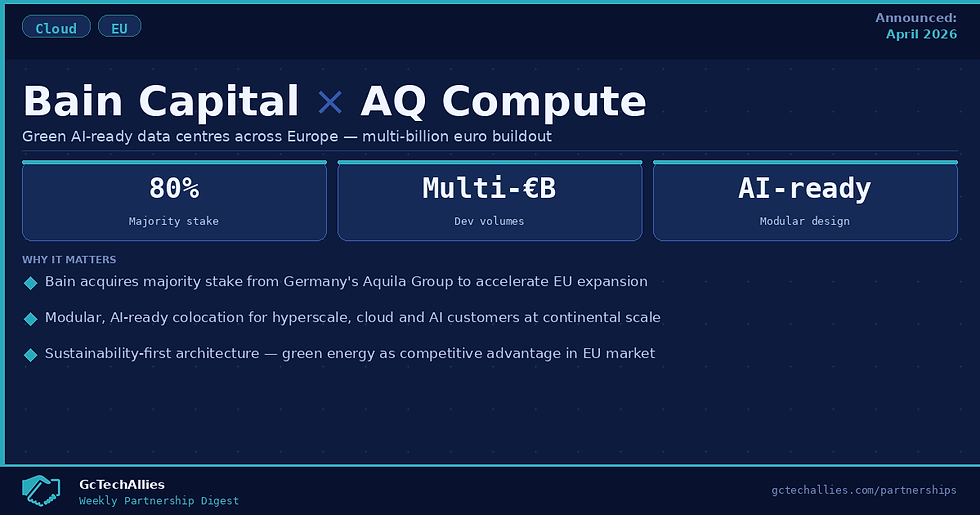
Bain Capital acquired an 80% majority stake in AQ Compute from Germany’s Aquila Group to accelerate the buildout of green, AI-ready data centres across Europe. The partnership targets multi-billion euro development volumes, offering modular colocation for hyperscale, cloud and AI customers with a sustainability-first approach.
What each party gets
Bain Capital: Control of scalable, future-proof AI infrastructure platform
AQ Compute: Capital + acceleration for pan-European expansion
Revenue implications
Long-term colocation and compute leasing revenues
Premium pricing for green, compliant AI infrastructure
Strong demand from hyperscalers and AI companies
Strategic intent
Bain: Build a dominant position in Europe’s AI infra layer
AQ Compute: Scale rapidly as a key EU compute provider
Who loses
Data centre operators without sustainability positioning
Regions lacking energy infrastructure for AI workloads
AI companies dependent on non-EU compute (regulatory risk)
Who should act
Energy + infra investors: This is a multi-decade play
AI companies: Secure compliant, EU-based compute capacity
Policy-driven funds: Align with EU sovereignty and ESG narratives
Opportunity score: ⭐⭐⭐⭐⭐ (5/5)
One of the most important long-term plays in Europe right now.
6.Visa Agentic Ready — 21 European Banks Launch AI Agent Payment Programme
Payments · Europe · March 17, 2026

Visa launched its Agentic Ready programme in Europe first, enrolling 21 issuing partners — including Barclays, HSBC UK, Commerzbank, Revolut, Santander, Nexi, Raiffeisen, DZ Bank and Nationwide — to test and validate AI agent-initiated payments in live production environments. Banco Santander already completed Europe’s first live AI agent payment using a Visa credential in Spain.
What each party gets
Visa: Control over AI-driven payment rails
Banks (e.g. Santander, Barclays, HSBC): Early access to next-gen payment capabilities
Revenue implications
New transaction volumes driven by AI-initiated payments
Expansion of tokenisation and API-based revenue streams
Potential increase in payment frequency (machines transacting)
Strategic intent
Visa: Stay central in payments as AI reshapes commerce
Banks: Avoid disintermediation by AI-native fintech layers
Who loses
Payment providers not integrated into AI ecosystems
Banks slow to adopt API/token infrastructure
UX-layer fintechs without backend control
Who should act
Fintech founders: Build for AI-native payment experiences
Banks: Accelerate API + tokenisation capabilities
Partnership Leads: Integrate early into agent-based ecosystems
Opportunity score: ⭐⭐⭐⭐⭐ (5/5)Potentially as big as the shift to mobile payments.
Solaris × SBI Group — Europe’s First AI-Native Bank Transformation
AI · Germany · March 2026

German Banking-as-a-Service platform Solaris repositioned as Europe’s first AI-native bank, backed by SBI Group. The transformation rebuilds all banking processes from the ground up using AI — not AI bolted onto legacy systems — with ADAC and Boerse Stuttgart as key live partners.
What each party gets
Solaris: Capital + strategic backing to rebuild banking stack
SBI Group: Entry into European AI-native banking infrastructure
Revenue implications
Lower operating costs via AI-driven processes
New revenue models from AI-native financial services
Potential to license infrastructure (BaaS evolution)
Strategic intent
Solaris: Leapfrog legacy banks with AI-first architecture
SBI: Expand global fintech footprint into Europe
Who loses
Traditional banks relying on legacy systems
BaaS providers not evolving toward AI-native models
High-cost operational banking structures
Who should act
Banks: Decide now—incremental AI or full transformation
VCs: Back AI-native financial infrastructure
Enterprise SaaS: Build tools for AI-first financial operations
Opportunity score: ⭐⭐⭐⭐☆ (4/5)
High upside, but execution risk is real.
8.LHV Bank × Gradient Labs — Europe’s First Agentic AI Banking Pilot
AI · UK · April 2026

LHV Bank launched a proof-of-concept with Gradient Labs — founded by ex-Monzo staff — to deploy AI agents for retail customer support. The pilot tests how explainable agentic AI can handle customer enquiries more efficiently and consistently without sacrificing accountability.
What each party gets
LHV Bank: Operational efficiency + innovation edge
Gradient Labs: Real-world validation in regulated banking
Revenue implications
Cost reduction in customer support operations
Potential increase in customer satisfaction → retention
Early foundation for AI-driven service monetisation
Strategic intent
LHV: Become a leader in AI-driven banking operations
Gradient Labs: Prove scalability of agentic AI in regulated environments
Who loses
Traditional call center-heavy banking models
AI vendors without explainability/compliance focus
Banks delaying AI adoption in operations
Who should act
Banks: Test agentic AI in low-risk environments (support, onboarding)
AI startups: Focus on explainability + compliance
Regulators / compliance teams: Prepare for AI-driven decision layers
Opportunity score: ⭐⭐⭐⭐☆ (4/5)
Early-stage—but strong signal of what’s coming.

Gianluca Caccamo connects leaders with data for strategic partnerships, after more than 15 years at companies like Google, Pinterest, and Wix among others. Advising companies on E-commerce, Advertising, SaaS, and AI Partnerships. [Linkedin]
Browse the full Partnership Feed
Visit the Partnership Feed on GcTechAllies to filter all deals by region (EU, North America, Asia) and category (AI, Payments, Logistics, Cloud, Fintech, SaaS, Ecommerce). Updated every week.
Weekly Partnership Digest, a news update provided by:


Comments